
• Home » News » Methyl Silicone Fluid vs Dimethyl Silicone Fluid...

Methyl Silicone Fluid vs Dimethyl Silicone Fluid: Full Technical Guide

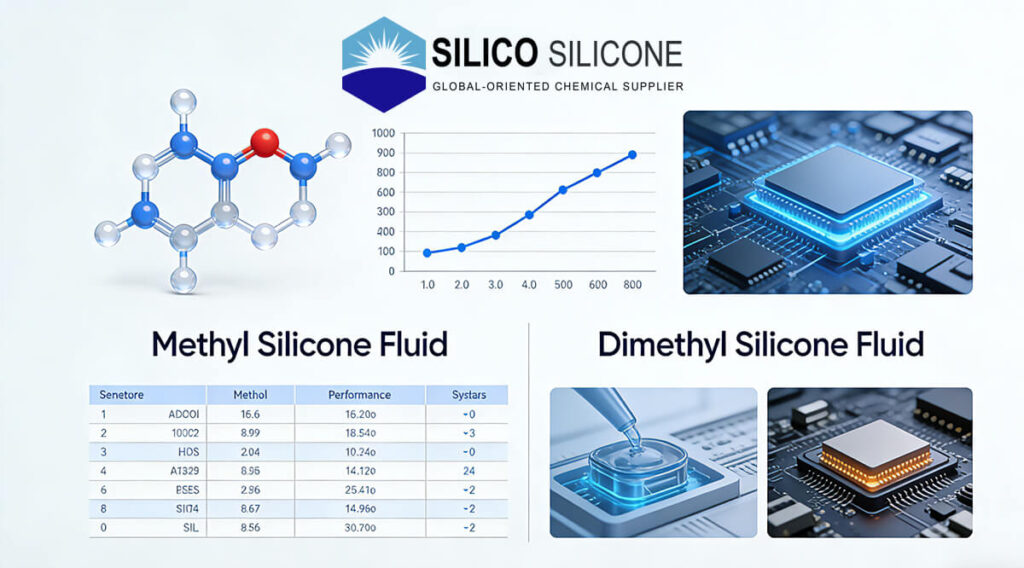
Methyl Silicone Fluid vs Dimethyl Silicone Fluid1

This guide explains the key differences between methyl silicone fluid and dimethyl silicone fluid, two widely used silicone oils in industrial and cosmetic applications. Dimethyl silicone (PDMS) is the standard choice for lubrication, cosmetics, dielectric fluids, and defoaming due to its stable viscosity, low surface tension, and reliable thermal performance up to ~150°C. Methyl silicone fluids—especially methylphenyl silicone—offer higher thermal stability, better oxidation resistance, improved optical properties, and superior radiation durability. This summary provides clear selection guidelines to help engineers and buyers choose the right silicone fluid based on temperature requirements, compatibility, viscosity, and regulatory needs.

1. Executive Summary (TL;DR)

  • Dimethyl silicone fluid—also known as PDMS (polydimethylsiloxane) or dimethicone—is the most widely used silicone oil. It offers excellent thermal stability (up to ~150°C), low surface tension, chemical inertness, and good dielectric performance.

  • “Methyl silicone fluid” is a broad, non-specific term. In many product catalogs, it includes not only dimethyl silicone but also methylphenyl silicone fluids and other modified types.

    • Methylphenyl silicone contains phenyl groups (C₆H₅-), which significantly enhance high-temperature stability, radiation resistance, and low-temperature flowability.

  • Practical takeaway:

    • For general lubrication, cosmetics, dielectric fluids, defoaming, choose dimethyl (PDMS).

    • For high-temperature, radiation, or extreme low-temperature conditions, choose methylphenyl silicone fluids.

2. Definitions: Why Confusion Happens

Dimethyl Silicone Fluid (PDMS / Dimethicone)

A linear silicone polymer composed mainly of repeating –Si(CH₃)₂–O– units. It is the standard, universal silicone oil used across cosmetics, electronics, and industrial lubrication.

Methyl Silicone Fluid

A vague term that simply means “silicone fluids containing methyl groups.”
However, in industrial catalogs, this category often also includes:

  • Dimethyl silicone (PDMS)

  • Methylphenyl silicone

  • Methylhydrogen silicone

  • Other modified silicone oils

Because the term is non-specific, it is not recommended for technical communication.
Always refer to chemical name / INCI / CAS number / TDS.

3. Structural Chemistry Differences

Dimethyl Silicone (PDMS)

  • Repeating unit: –[Si(CH₃)₂–O]–
  • Low polarity, highly flexible backbone
  • Extremely low surface tension and excellent spreadability

Methylphenyl Silicone

  • Repeating unit includes: –Si(CH₃)(C₆H₅)–
  • Phenyl groups increase:
    • Molecular rigidity
    • Thermal oxidation resistance
    • Radiation resistance
    • Optical refractive index
    • Compatibility with organic solvents/resins
Structural consequence:
Phenyl substitution fundamentally changes thermal, chemical, and optical behavior, making methylphenyl silicone appropriate for high-performance applications.

4. Performance Comparison

Below is a consolidated, professional-grade comparison for engineers and formulators.

① Thermal Stability

PropertyDimethyl Silicone (PDMS)Methylphenyl Silicone
Long-term service temperature~150°CUp to ~250°C
Oxidation resistanceModerateSignificantly better
Thermal decompositionEarlierDelayed due to phenyl stabilization

② Low-Temperature Fluidity

  • PDMS: excellent flowability down to –50°C
  • Methylphenyl: certain grades maintain flow down to –60°C or below

③ Viscosity–Temperature Behavior (VTG)

  • PDMS shows very low VTG (very stable viscosity across temperature)
  • Phenyl groups tend to increase VTG and alter the viscosity curve

④ Optical Properties

  • PDMS refractive index: ~1.39–1.41
  • Phenyl-modified fluids: higher refractive index, due to higher electron polarizability
    → important for optical materials or resin compatibility

⑤ Surface Tension & Wetting

  • PDMS: extremely low surface tension, excellent spreadability
  • Methylphenyl: surface behavior can be tailored, better compatibility with certain resins

⑥ Radiation & Chemical Stability

  • PDMS: chemically inert but sensitive to high-energy radiation
  • Methylphenyl: superior radiation stability, suitable for nuclear/medical devices

5. Application Comparison

Cosmetics / Personal Care

  • Preferred: PDMS (Dimethicone)
    • Smooth, non-greasy skin feel
    • Film-forming & conditioning properties
    • Globally recognized INCI name
  • Methylphenyl is seldom used except for high-temperature styling products or film-forming systems.

Industrial Lubrication & Release Agents

  • PDMS works for most applications
  • For high-temperature lubrication, methylphenyl is significantly more stable

Defoaming Applications

  • PDMS is standard due to low surface tension
  • Phenyl-modified silicone used when specific resin compatibility is required

Heat Transfer Fluids / Hot Oil Baths

  • Methylphenyl silicone is the preferred choice
  • High thermal stability prevents degradation at elevated temperatures

Electronics / Electrical Insulation

  • PDMS: excellent dielectric properties
  • Methylphenyl: used when high-temperature dielectric stability is needed

Optical Materials / Coatings

  • Phenyl-modified silicone improves refractive index for optical clarity adjustments

6. How to Choose the Right Silicone Fluid

A practical step-by-step method:

Step 1 — Define the operating temperature

  • ≤150°C → PDMS is suitable
  • ≥150°C (continuous) → choose methylphenyl silicone

Step 2 — Evaluate compatibility

Consider resins, solvents, oils, polymer systems.

Step 3 — Select viscosity grade

Silicone fluids are sold from 0.65 to >100,000 cSt.
Lower viscosity = better flow / spreading
Higher viscosity = thicker film, better damping

Step 4 — Regulatory compliance

For cosmetics: check INCI name, REACH/TSCA status, and cosmetic-grade certification.
For electronics: check dielectric strength and impurity limits.

Step 5 — Validate with application testing

Include:
  • Thermal aging
  • Low-temperature cycling
  • Radiation exposure (if relevant)
  • Long-term material compatibility tests

7. Key TDS Parameters to Review

When comparing suppliers, prioritize the following:
  • Viscosity (25°C)
  • Viscosity index / Viscosity–Temperature Curve
  • Density
  • Refractive Index
  • Pour Point & Flash Point
  • Volatility / Weight Loss at High Temperature
  • Dielectric Strength & Volume Resistivity
  • Residual chlorine, sulfur, or metal content
  • End-group type (hydroxyl, vinyl, trimethyl)

A full review of the TDS ensures a correct engineering decision.

8. Safety, Storage, and Compliance

  • Store in sealed containers at ambient temperature
  • Avoid contamination by acids, alkalis, or moisture
  • Check SDS for grade-specific hazards
  • For cosmetic use, confirm INCI name accuracy and verify purity levels
  • For food/medical contact, ensure compliance with USP/NF or FDA requirements

9. Common Misconceptions

Misconception 1:
“Methyl silicone fluid” = “dimethyl silicone fluid.”
→ Incorrect. The term is ambiguous and often includes methylphenyl grades. Always verify via TDS/CAS.

Misconception 2:
“Same viscosity means same performance.”
→ Incorrect. Structural substituents (e.g., phenyl groups) drastically change thermal, optical, and chemical behavior.

Misconception 3:
“Dimethicone clogs pores.”
→ Generally false. Dimethicone is considered non-comedogenic, but final product behavior depends on the entire formula.

10. Final Recommendation

If you need a universal, cost-effective, high-purity, chemically inert silicone fluid for cosmetic, lubrication, insulation, or defoaming applications:
→ Choose Silico® dimethyl silicone fluid (PDMS / Dimethicone).

If you require high-temperature stability, radiation resistance, enhanced optical properties, or extreme low-temperature performance:
→ Choose Silico® Methylphenyl Silicone Fluid.

Silico®’s structure-driven selection ensures the highest reliability across industrial, cosmetic, electronic, and high-temperature environments.

Popular Recommendations

Get a Catalog & Best Price​

  • Quick and helpful reply within 24 hours;
  • Tailored solutions provided for your project;
  • One-stop purchasing service.
Please enable JavaScript in your browser to complete this form.
  • © Copyright 2022 Silico® . All Rights Reserved.
Scroll to Top