
2026-03-26


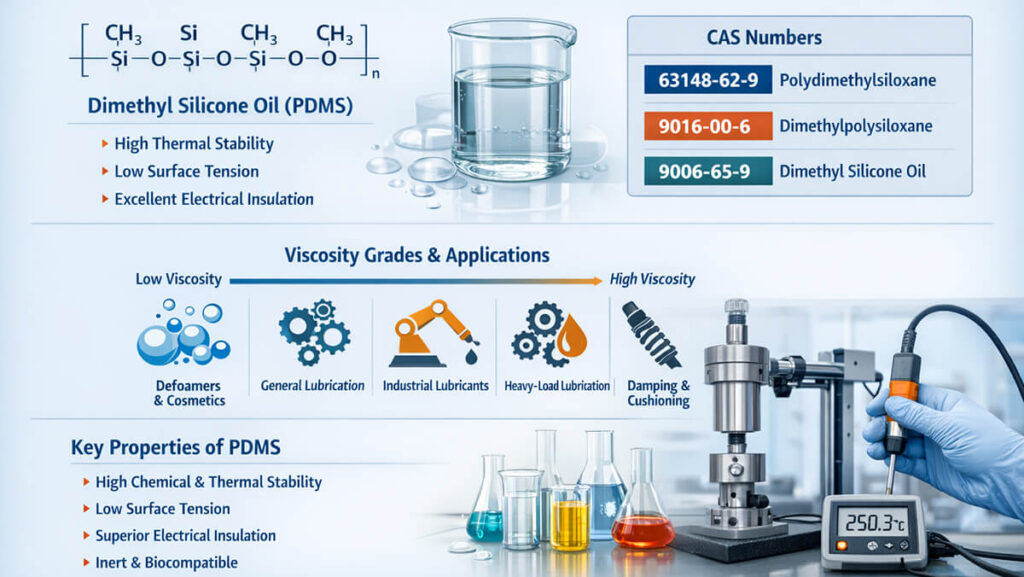
Dimethyl Silicone Oil, also known as Polydimethylsiloxane (PDMS), is a key functional fluid in the organosilicon industry. Its chemical inertness, high thermal stability, low surface tension, excellent electrical insulation, and broad viscosity range make it essential across industrial lubrication, defoaming, mold release, electronics, thermal management, personal care, cosmetic, and medical applications.
Silico® provides high-quality, application-optimized PDMS solutions designed for consistent performance in industrial use.
PDMS is commonly listed under multiple CAS numbers (63148-62-9, 9016-00-6, 9006-65-9), which can cause confusion in procurement, technical specifications, and formulation. This article clarifies these CAS numbers, physical properties, viscosity grades, and application selection guidance to support accurate technical decision-making.
Dimethyl silicone oil is essentially a linear polysiloxane fluid composed of repeating –Si(CH₃)₂–O– units. Its backbone consists of silicon–oxygen (Si–O–Si) bonds, which exhibit significantly higher bond energy and greater molecular flexibility compared to conventional carbon-chain polymers.
This unique molecular structure is the fundamental reason why PDMS maintains stable physical properties over a wide temperature range.
At room temperature, dimethyl silicone oil is typically a colorless, transparent, odorless, non-polar liquid. It is insoluble in water but compatible with many organic solvents.
The typical service temperature range spans from –50 °C to 200 °C, and certain high-grade products can operate beyond this range under inert conditions.
This CAS number appears mainly in earlier industrial literature, legacy databases, and traditional industry standards.
Although less frequently used in new projects, it refers to the same linear PDMS chemical entity as CAS 63148-62-9.
Understanding this distinction is critical for avoiding misunderstandings in cross-border procurement, regulatory compliance, and technical communication.
| Viscosity Range (cSt) | Relative Density (25 °C) | Flash Point (°C) | Typical Applications |
|---|---|---|---|
| 5–20 | 0.90–0.95 | ≥80–200 | Defoamers, personal care formulations, precision lubrication |
| 50–100 | 0.95–0.97 | ≥250–310 | General-purpose silicone oil, light-load lubrication |
| 350–500 | 0.96–0.97 | ≥290–315 | Industrial lubrication, mold release agents |
| 1,000–5,000 | 0.96–0.97 | ≥290–315 | Industrial lubrication, mold release agents |
| 10,000–30,000 | ≈0.97 | >300 | Heavy-load lubrication, sealing media |
| >100,000 | ≈0.97 | >300 | Damping fluids, buffering and vibration control systems |
Low-viscosity PDMS: Excellent flowability and rapid surface spreading; ideal for defoaming, surface treatment, and cosmetic formulations
Medium-viscosity PDMS: Balanced performance; the most widely used grade in industrial applications
High-viscosity PDMS: Thick, stable films with strong load-bearing capacity; suitable for damping, cushioning, and high-temperature environments
Due to the robust siloxane backbone, dimethyl silicone oil maintains consistent performance under high temperature, humidity, electrical fields, and mechanical shear, making it a preferred choice for dielectric fluids and thermal management systems.
At this performance level, Silico® PDMS products are engineered to ensure viscosity stability and batch-to-batch consistency across demanding industrial environments.
When selecting dimethyl silicone oil for a specific application, a systematic evaluation should consider:
CAS number alignment: Ensure consistency between procurement documents and technical specifications

This approach ensures optimal performance across industrial, chemical, and formulation-based applications.
Silico® provides a full viscosity range of dimethyl silicone oils with stable molecular architecture and export-ready documentation to meet diverse global requirements.
The three commonly used CAS numbers—63148-62-9, 9016-00-6, and 9006-65-9—all refer to dimethyl silicone oil based on linear PDMS chemistry. Their differences lie mainly in historical usage, regulatory habits, and application-oriented naming, rather than in fundamental physical or chemical properties.
For engineers, formulators, and procurement specialists, viscosity grade, purity, and application fit should always take priority over CAS nomenclature.
Silico® remains committed to supplying reliable, high-performance dimethyl silicone oils designed for industrial lubrication, release, defoaming, and advanced material applications worldwide.